
How to Teach When You’re Completely Burnt Out
April 6, 2026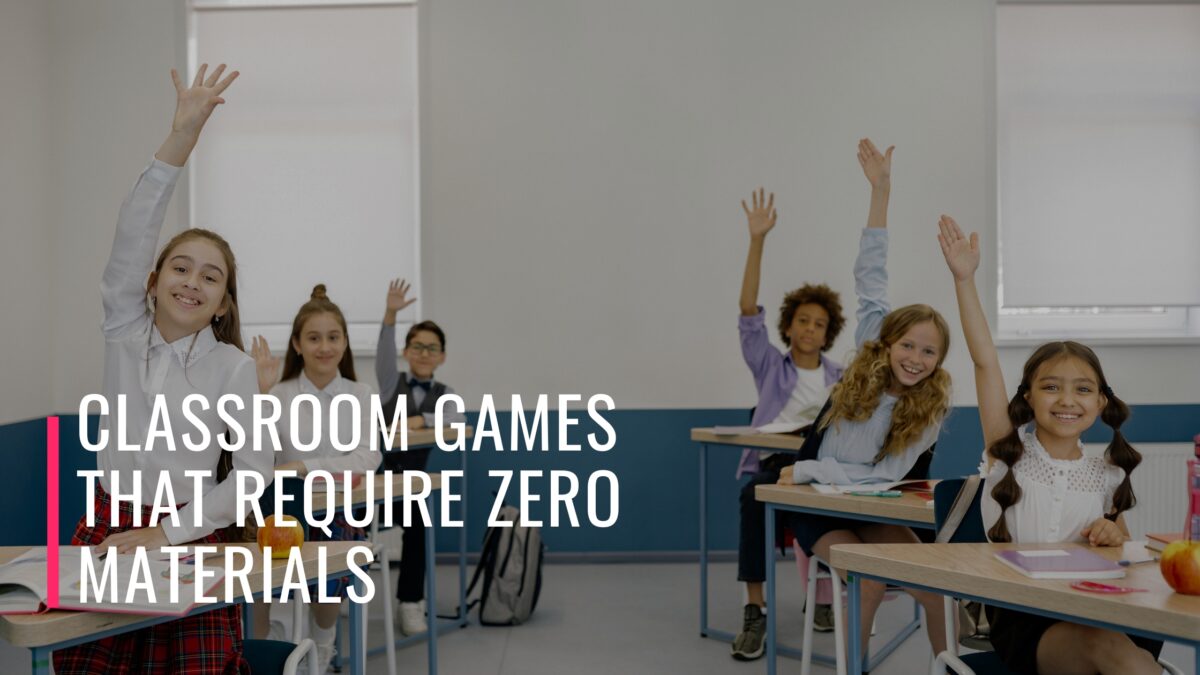
You’ve got a few minutes left in class. Your students are restless, your energy is low, and you don’t have anything prepared.
No worksheets. No slides. No materials.
Just you and a room full of students.
Instead of letting those minutes slip into chaos, this is where zero-prep classroom games can save you. These quick, no-material activities can boost energy, improve focus, and reinforce learning without adding any extra work to your day.
In this post, you’ll discover classroom games that require zero materials, all simple, flexible, and easy to use anytime you need them.
Why Zero-Material Games Work
Sometimes the simplest activities are the most effective.
Zero-material games:
Save time and preparation
Reduce classroom clutter
Allow you to adapt instantly
They also encourage participation and interaction, which increases engagement.
Research on active learning shows that students learn better when they are involved, not just listening. These games create that involvement without any setup.
20 Questions
One student thinks of a word, object, or concept. The class asks yes or no questions to figure it out.
Example:
“Is it a place?”
“Can you eat it?”
You can guide it based on your lesson.
In a science class, students can guess an animal or element. In English, it could be vocabulary words.
This builds questioning and critical thinking skills.
Stand Up If…
This game adds movement and quick thinking.
Call out statements and students stand if it applies to them.
Example:
“Stand up if you agree with this idea”
“Stand up if this sentence is correct”
You can easily connect it to your lesson content.
It’s fast, energizing, and keeps everyone involved.
Would You Rather (Content Edition)
Ask students to choose between two options and explain their reasoning.
Example:
“Would you rather live in the past or the future?”
“Would you rather write an essay or give a presentation?”
To deepen learning, require students to justify their answers.
This encourages speaking and critical thinking.
Hot Seat
One student sits at the front facing the class.
You write or think of a word. The class gives clues without saying the word itself.
The student has to guess.
For example:
If the word is “democracy,” students might say:
“It’s a type of government”
“People vote”
This works well for vocabulary review and concept reinforcement.
Two Truths and a Lie
A student shares three statements. Two are true, one is false.
The class guesses which one is the lie.
To connect it to learning:
Statements can be about a lesson topic.
For example, in history:
“I was born in 1800”
“I was a king”
“I discovered electricity”
Students must think carefully and use prior knowledge.
Last Person Standing
Ask a question related to your lesson.
Students take turns answering. If they can’t answer or repeat an answer, they sit down.
The last person standing wins.
Example:
“Name as many adjectives as you can”
“List types of energy”
This game encourages quick recall and keeps students alert.
Word Chain
Start with a word. Each student adds another word connected to it.
Example:
Teacher says: “Ocean”
Student: “Fish”
Next student: “Water”
You can set rules:
Same topic
Same category
Same starting letter
This works well for vocabulary building and brainstorming.
Common Mistakes to Avoid
Letting games become too competitive
Keep the focus on participation, not just winning
Choosing games without clear instructions
Simple rules help activities run smoothly
Not linking games to learning
Even fun activities can reinforce content
Overusing the same game
Variety keeps students interested
Simple Ways to Make It Even Easier
You don’t need materials, but a little planning helps.
Keep a mental list of your favorite games so you’re never stuck.
Adapt games for different subjects by changing the content.
For example, the same game can be used for vocabulary, science terms, or historical facts.
This flexibility makes zero-material games a powerful tool in any classroom.
Conclusion
You don’t need materials to create an engaging classroom.
With a few simple games, you can boost energy, improve participation, and make the most of every minute.
Zero-prep activities give you flexibility when things don’t go as planned or when you just need a quick reset.
Start by trying one or two games this week.
Over time, you’ll build a set of go-to strategies that make your classroom feel more active and enjoyable, without adding extra work.
If you’re looking for more ready-to-use classroom ideas, prompts, or activities, explore resources that help you save time while keeping your lessons engaging.
- Art9 products
- English74 products
- Growth Mindset18 products
- History28 products
- Math7 products
- Music8 products
- PE5 products
- Science15 products
- Social Studies18 products