Affordable Classroom Posters for Teachers | Rad Tutor Gallery
February 11, 2026
Best Classroom Posters for Back to School | Rad Tutor Gallery
February 16, 2026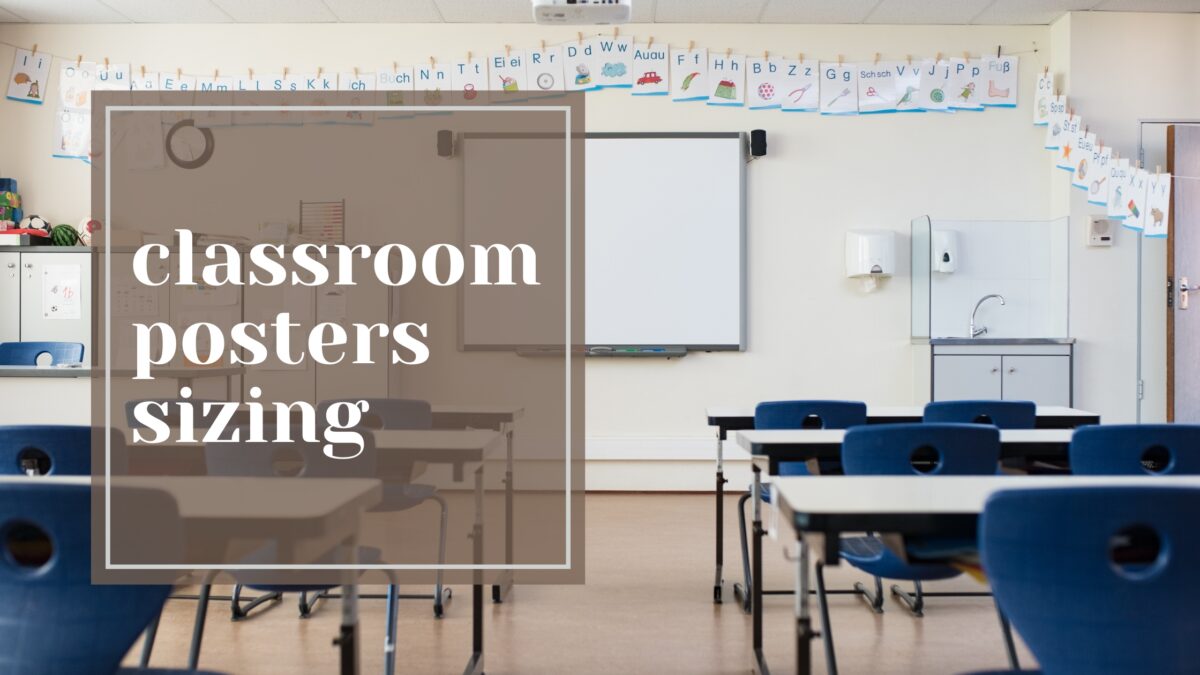
When setting up a learning space, visibility and readability matter more than most teachers realize. A beautifully designed poster won’t support learning if students in the back row can’t read it. On the other hand, oversized wall displays can overwhelm younger learners or clutter already busy walls. Choosing the right poster size for classroom posters is about balancing clarity, distance, and visual harmony.
Whether you teach in a compact elementary classroom or a spacious high school setting, understanding common poster sizes and how they function in different spaces will help you make intentional decisions for your walls.
Why Poster Size Matters in the Classroom
Effective educational wall art should do more than decorate. It should reinforce concepts, support routines, and provide quick-reference visuals. If students need to squint or walk across the room to read a grammar rule or math formula, the poster isn’t serving its purpose.
Here’s why size plays a crucial role:
- Readability from a distance
- Proportion to wall space
- Visual balance with other materials
- Printing practicality and cost
When teachers choose appropriate poster sizes for classroom use, they create an environment that feels organized and intentional rather than cluttered.
Common Poster Sizes for Classrooms
Let’s break down the most popular sizes teachers use and when each works best.
1. A4 (8.3 x 11.7 inches) or 8.5 x 11 inches
This size is similar to standard printer paper and is one of the most accessible options.
Best for:
- Vocabulary lists
- Small reminders
- Behavior expectations near specific areas (like a reading corner)
- Close-up viewing spaces
A4 posters are ideal for smaller displays or when students will be standing nearby. However, they may not be visible from the back of a larger classroom.
Because they’re easy to print at home or at school, many teachers prefer this size when working with printable classroom decor.
2. A3 (11.7 x 16.5 inches) or 11 x 17 inches
This size is often considered the “sweet spot” for classroom posters.
Best for:
- Anchor charts
- Grammar rules
- Math strategies
- Science diagrams
A3 or 11×17 posters are large enough to be readable from several meters away, yet not so large that they dominate the wall. They work particularly well in middle school and high school classrooms where students need clear reference materials.
If your classroom has 20–30 students and typical row seating, this size usually provides strong visibility without overcrowding the space.
3. A2 (16.5 x 23.4 inches) or 18 x 24 inches
Now we’re moving into statement-piece territory.
Best for:
- Classroom rules displayed at the front
- Visual learning posters summarizing key units
- Inspirational quotes for large walls
- Year-long reference charts
This size works especially well for front-of-room displays where students regularly look during instruction. It ensures readability even for students seated in the back row.
However, in a smaller classroom, too many large posters can feel overwhelming. Moderation is key.
4. Large Format (24 x 36 inches and above)
These are commonly used for high-impact visuals or themed displays.
Best for:
- Feature walls
- Themed decor areas
- School-wide events
- Bulletin board backdrops
In everyday instructional use, oversized posters should be used intentionally. They are effective for high-visibility zones but not necessary for every concept.
How to Choose the Right Size for Your Classroom
There’s no universal “correct” size for classroom posters. Instead, consider these factors:
1. Viewing Distance
A helpful guideline:
The farther students sit, the larger the text and poster should be.
If your classroom is deep and students sit more than 4–5 meters away from the front wall, A3 or larger is often the better choice.
2. Wall Space Availability
Measure your wall before printing. Teachers sometimes underestimate how much space multiple posters take up.
In smaller rooms:
- Use A4 or A3 sizes.
- Group related posters into clean, structured sections.
- Leave white space between displays.
In larger rooms:
- Use A3 or A2 for key concepts.
- Create focal points with slightly larger educational wall art.
- Avoid scattering tiny posters across wide walls.
3. Age Group of Students
Younger learners benefit from:
- Larger fonts
- Bigger visuals
- Fewer words per poster
Older students can handle:
- Denser information
- Smaller print (if readable)
- More detailed anchor charts
Adjust your poster sizes for classroom needs based on developmental level.
Tips for Small Classrooms
If you’re working in a compact classroom:
- Stick to A4 or A3 sizes.
- Rotate posters by unit instead of displaying everything at once.
- Use vertical wall space efficiently.
- Avoid covering every wall.
A smaller space benefits from intentional design. Overdecorating can distract students rather than support learning.
Tips for Large Classrooms
In bigger classrooms:
- Use A3 or A2 for front-facing instructional posters.
- Ensure important information is readable from the back row.
- Create themed zones (reading corner, writing wall, math strategy wall).
- Use larger pieces strategically rather than randomly.
Balance is essential. Even in large spaces, too many oversized visuals can create visual noise.
The Advantage of Printable Flexibility
One of the biggest advantages of modern printable classroom decor is adaptability.
“Downloadable printable classroom decor gives teachers flexibility to choose the exact size that fits their space.”
Instead of being limited to one pre-printed size, teachers can scale files up or down depending on wall dimensions, printer capabilities, and student needs. You might print an anchor chart in A3 for the front wall and the same design in A4 for small group tables.
This flexibility makes printable classroom posters a practical and cost-effective option. High-quality printable designs allow teachers to invest once and reuse materials year after year.
If you’re looking for thoughtfully designed resources that can be resized to suit different classrooms, you can explore my collection of printable classroom posters and teaching wall art here. The designs are created with readability and classroom practicality in mind, making it easier to choose the right size for your space.
Final Thoughts
So, what size should classroom posters be?
The answer depends on visibility, distance, wall space, and student age.
- Use A4 for close-up displays.
- Choose A3 or 11×17 for everyday instructional reference.
- Reserve A2 or larger for high-impact focal points.
Well-sized classroom posters enhance clarity, support instruction, and contribute to a calm, organized environment. When size is chosen intentionally, educational wall art becomes more than decoration—it becomes a functional teaching tool.
By considering space, readability, and flexibility, teachers can create classrooms that are both beautiful and purposeful.
- Art20 products
- Class Management26 products
- English152 products
- Growth Mindset70 products
- History59 products
- Kids6 products
- Math19 products
- Music17 products
- PE18 products
- Science74 products
- Social Studies57 products